M001
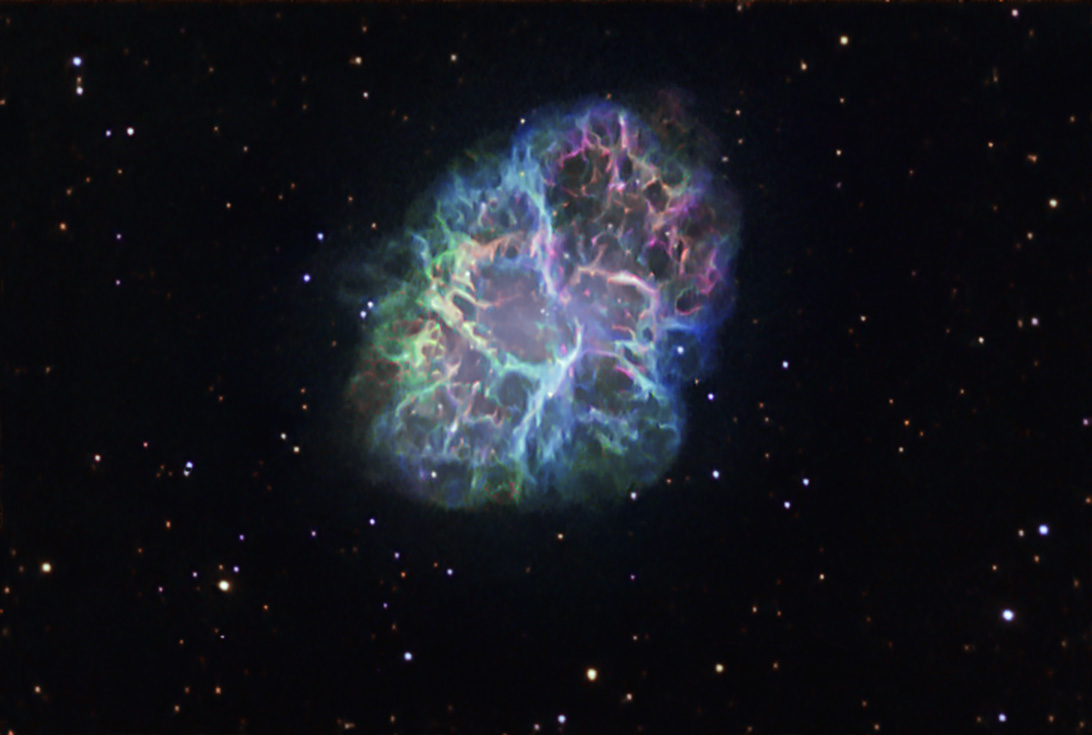
The Crab Nebula - Narrowband
Image Credit: Ron DiIulio - Image Date: January 2019
Equipment: 16 in. RC Telescope - QHY-3200 Camera - Paramount Mount
M16 - The Eagle Nebula 1
The Crab Nebula, created by the explosion of a massive star, is located in the constellation Taurus>, and is possibly the most famous supernova remnant in the sky. It was observed, and documented, by Chinese astronomers on July 4, 1054. The "new star" was about four times brighter than Venus. It was so bright that it could be seen in daylight for 23 days and 653 days in the night sky. Charles Messier independently found the nebula on August 28, 1758 when he was looking for comet Halley on its first predicted return. He first thought it was a comet but soon recognized that it had no apparent proper motion. It was the discovery of this object which caused Charles Messier to begin the compilation of his famous catalog. The nebula consists of material ejected by the supernova explosion. The nebula has expanded over a volume of space approximately 10 light years in diameter. It is still expanding at a velocity of about 1,800 km/sec.; On November 9, 1968, a pulsating radio source, the Crab Pulsar< (PSR B0531+21), was discovered in M1 by astronomers using the 300-meter radio telescope in Puerto Rico. It has now been established that this pulsar is a rapidly rotating neutron star. It rotates about 30 times per second. The pulsar is the dim star in the center of the image above. The Crab Nebula is approximately 6,300 to 6,500 light-years distant.
The image above was compiled from narrowband filtered exposures< to create a mapped color depiction of the nebula. The standard Hubble pallet of SII mapped to red, Ha mapped to green, and OIII mapped to blue was utilized for the image.
The Crab Nebula, created by the explosion of a massive star, is located in the constellation Taurus>, and is possibly the most famous supernova remnant in the sky. It was observed, and documented, by Chinese astronomers on July 4, 1054. The "new star" was about four times brighter than Venus. It was so bright that it could be seen in daylight for 23 days and 653 days in the night sky. Charles Messier independently found the nebula on August 28, 1758 when he was looking for comet Halley on its first predicted return. He first thought it was a comet but soon recognized that it had no apparent proper motion. It was the discovery of this object which caused Charles Messier to begin the compilation of his famous catalog. The nebula consists of material ejected by the supernova explosion. The nebula has expanded over a volume of space approximately 10 light years in diameter. It is still expanding at a velocity of about 1,800 km/sec.; On November 9, 1968, a pulsating radio source, the Crab Pulsar< (PSR B0531+21), was discovered in M1 by astronomers using the 300-meter radio telescope in Puerto Rico. It has now been established that this pulsar is a rapidly rotating neutron star. It rotates about 30 times per second. The pulsar is the dim star in the center of the image above. The Crab Nebula is approximately 6,300 to 6,500 light-years distant.
The image above was compiled from narrowband filtered exposures< to create a mapped color depiction of the nebula. The standard Hubble pallet of SII mapped to red, Ha mapped to green, and OIII mapped to blue was utilized for the image.
